Decoding E-E-A-T: Why Search and AI Platforms Trust Your Content
Discover how Experience, Expertise, Authoritativeness, and Trustworthiness (E-E-A-T) dictate visibility across Google and modern AI search engines. Learn actionable steps to prove your site's credibility.
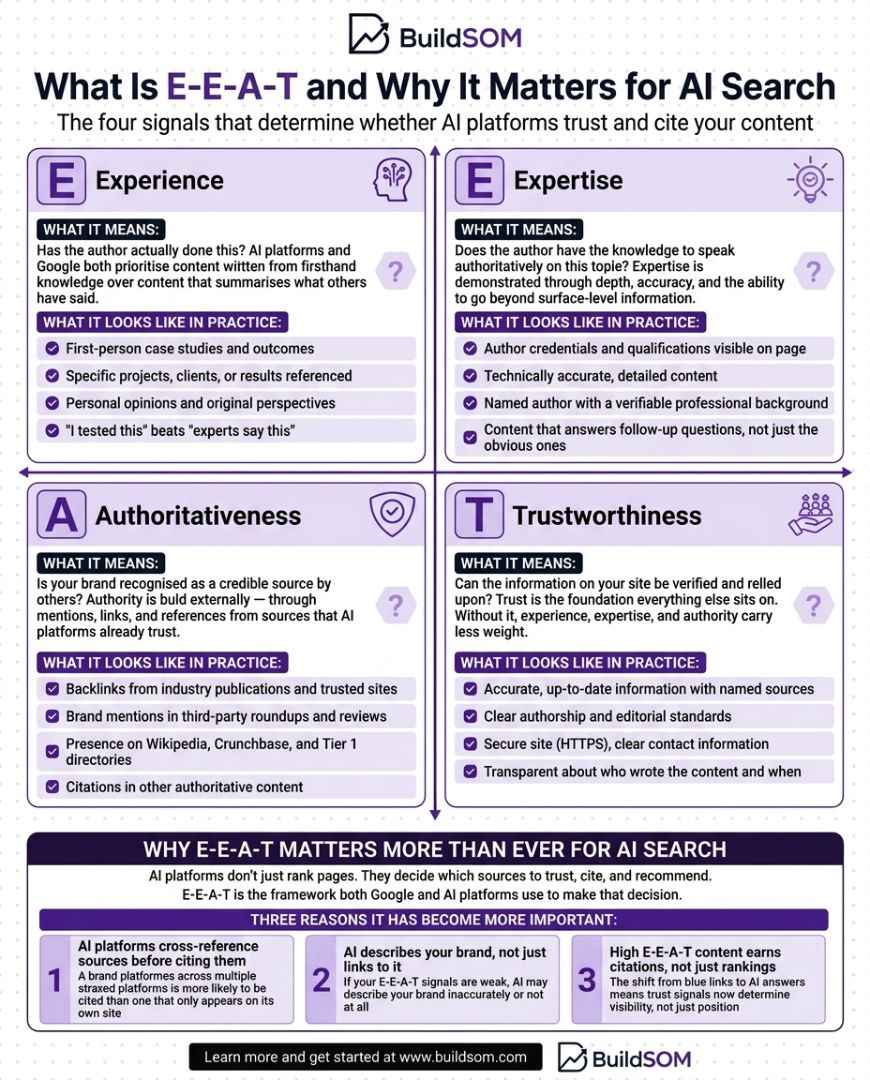
Decoding E-E-A-T: Why Search and AI Platforms Trust Your Content
Search algorithms have undergone a fundamental shift. It is no longer enough to target high-volume keywords or craft well-structured articles. Both traditional search engines like Google and generative AI platforms (such as ChatGPT, Perplexity, and Claude) actively filter for digital trust and author credibility.
At the center of this transition sits E-E-A-T—an acronym for Experience, Expertise, Authoritativeness, and Trustworthiness. Originating in Google's Search Quality Rater Guidelines, E-E-A-T has evolved into the core framework used across search and AI systems to decide which brands to cite, rank, and recommend.
Here is a breakdown of what each signal entails, how to implement them in practice, and why E-E-A-T is vital for visibility in the age of AI search.
The Four Pillars of E-E-A-T
  +-------------------------------------------+----------------------------------------------+
  |                EXPERIENCE              |                 EXPERTISE                   |
  |  Firsthand, practical involvement |  Deep knowledge & qualifications  |
  +-------------------------------------------+----------------------------------------------+
  |         AUTHORITATIVENESS      |           TRUSTWORTHINESS         |
  | External recognition & citations  | Accuracy, security & transparency  |
  +-------------------------------------------+----------------------------------------------+
1. Experience (Firsthand Application)
Experience focuses on whether the author has practical, real-world familiarity with the subject matter. AI models and search raters prioritize original insights over synthesized summaries of existing web pages.
- What it means: Firsthand trial, execution, and direct observation outweigh theoretical knowledge. "I tested this" carries significantly more weight than "experts say this."
- How to demonstrate it:
- Publish first-person case studies highlighting concrete results and metrics.
- Reference specific projects, client engagements, or direct experiments.
- Share original perspectives, lessons learned, and personal commentary.
2. Expertise (Subject-Matter Depth)
Expertise evaluates whether the writer possesses the formal qualifications, credentials, or comprehensive understanding required to speak on a topic.
- What it means: True expertise goes beyond surface-level answers to thoroughly address nuance, technical edge cases, and follow-up questions.
- How to demonstrate it:
- Feature detailed, verifiable author bios on article pages.
- Publish technically accurate, well-researched content that thoroughly unpacks complex ideas.
- Ensure content creators have documented background or professional history in their subject area.
3. Authoritativeness (Industry Recognition)
While Experience and Expertise stem from within your brand, Authoritativeness is built externally. It reflects how the broader industry views your site as a credible reference.
- What it means: AI models look for external validation to determine if a brand is recognized as an industry leader.
- How to demonstrate it:
- Secure high-quality backlinks from established industry publications and trusted domains.
- Earn brand mentions in third-party product roundups, reviews, and news coverage.
- Maintain a active presence on trusted authority nodes like Wikipedia, Crunchbase, and Tier 1 business directories.
4. Trustworthiness (The Core Foundation)
Trustworthiness is the foundational pillar of the entire E-E-A-T model. Without explicit trust, strong experience, expertise, and authoritativeness carry little weight.
- What it means: Users and AI platforms must be able to rely on the accuracy, security, and intent of your site.
- How to demonstrate it:
- Cite accurate, up-to-date data with named references and sources.
- Maintain clear editorial standards, transparent publishing timestamps, and complete contact details.
- Ensure technical web security protocols (HTTPS) and clear terms of service.
Why E-E-A-T Matters More Than Ever for AI Search
AI platforms do not merely rank pages in a list of blue links; they synthesize answers and actively select which brands to trust, cite, and present to users. Three specific shifts explain why E-E-A-T is essential in AI search:
- AI Cross-References Sources Before CitingLarge language models pull from multiple data points. A brand referenced across diverse, authoritative platforms is far more likely to be cited in an AI summary than one appearing exclusively on its own domain.
- AI Describes Brands, Not Just Links to ThemIf your E-E-A-T signals are weak or unverified, AI engines may summarize your brand inaccurately or leave you out of recommendations entirely.
- High E-E-A-T Earns Citations, Not Just RankingsAs search transitions toward conversational answers, visibility depends on earning direct citations. Strong trust signals determine whether your content is cited inside the answer box.
Next Steps
To audit your current digital footprint and strengthen your content strategy, explore expert search strategies and resources at BuildSOM. Aligning your publishing strategy with E-E-A-T signals ensures your content remains visible across both traditional search engines and emerging AI platforms.