Is Your Brand Ready for AI Search? A Step-by-Step Optimization Checklist
Discover if your brand is visible in AI search engines like ChatGPT, Gemini, and Perplexity, and learn actionable steps to optimize your web presence for LLM citations.
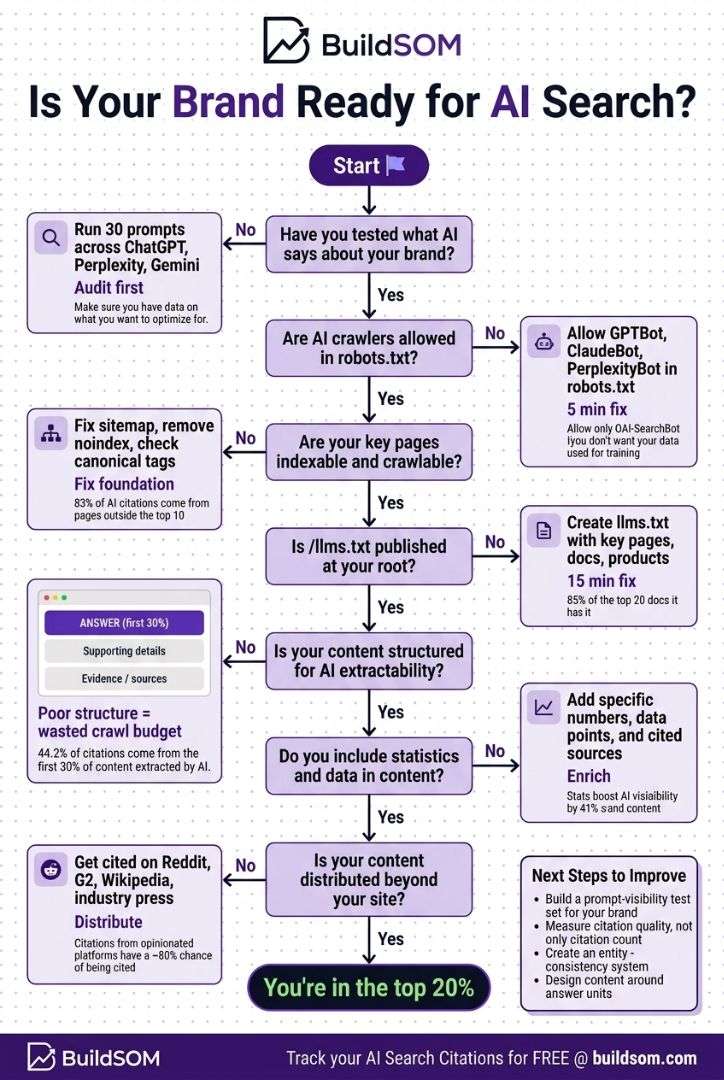
Is Your Brand Ready for AI Search? A Step-by-Step Optimization Checklist
Traditional Search Engine Optimization (SEO) focused heavily on ranking in the top ten blue links of traditional search engine results pages. However, the rise of Large Language Models (LLMs) and Generative Engine Optimization (GEO) has fundamentally transformed how consumers discover information online. AI search engines—such as ChatGPT, Perplexity, and Google Gemini—synthesize answers directly for users, attributing their findings to trusted web sources.
If your brand isn’t structured or accessible for AI extraction, you risk disappearing from the digital landscape entirely. Below is a comprehensive audit and optimization checklist based on key technical and structural milestones required to ensure your brand thrives in the age of AI search.
1. Audit Your Current AI Search Presence
Before changing code or restructuring content, establish a baseline for how AI engines currently perceive your brand.
- Run a Prompt Audit: Test at least 30 targeted prompts across leading AI platforms, including ChatGPT, Perplexity, and Google Gemini.
- Evaluate Responses: Check whether AI engines mention your brand, accurately describe your product offerings, or cite your competitors instead.
- Gather Data: Document your citation baseline so you know exactly what messaging and entities you need to optimize for.
2. Technical Accessibility: Crawlers, Indexability, and llms.txt
If AI web crawlers cannot access or parse your pages, your content will never be cited. Technical foundation forms the bedrock of AI search readiness.
Allow AI Crawlers in robots.txt
Ensure your server isn't explicitly blocking user-agents like
GPTBot, ClaudeBot, or PerplexityBot. If you want your site cited in search responses without opting into model training, configure search-specific bots (like OAI-SearchBot) appropriately in your robots.txt. Allowing these crawlers is often a 5-minute fix that immediately restores visibility. Fix Crawling & Indexing Foundations
Research reveals that 83% of AI citations originate from pages outside the top 10 traditional search results. This means even deep pages can generate significant traffic if accessible.
- Inspect your sitemap for accuracy.
- Remove accidental
noindextags on high-value resources. - Ensure canonical tags correctly point to primary content hubs.
Publish an /llms.txt File
Similar to
robots.txt, an /llms.txt file located at your root domain provides an explicit, markdown-formatted directory of key pages, product documentation, and specs tailored specifically for LLMs. While it takes roughly 15 minutes to configure, 85% of top documentation sites have already adopted this format to streamline AI scraping. 3. On-Page Content Optimization for Extractability
Structuring page content for machine readability is critical for ensuring AI bots capture and credit your information efficiently.
+--------------------------------------------------------------------------+
|   ANSWER (First 30% of content)  -->  44.2% Citations   |
+--------------------------------------------------------------------------+
|                   Supporting Details & Context                         |
+--------------------------------------------------------------------------+
|                   Evidence, Data & Sources                             |
+--------------------------------------------------------------------------+
Front-Load Key Answers
AI models operate on tight crawl context windows. 44.2% of AI citations are extracted directly from the first 30% of page content. Poorly structured pages with long-winded intros waste crawl budgets and lower your chances of being quoted.
- Answer core questions immediately in the first few paragraphs.
- Place summary takeaways at the top of long-form articles.
Enrich Content with Data Points & Statistics
Abstract claims are rarely cited by LLMs, which favor concrete factual statements. Including hard numbers, specific metrics, and verified data sources can boost AI visibility by up to 41%.
4. Off-Page Distribution & Entity Building
AI search models rely heavily on third-party consensus to determine source authority and credibility.
Citations from opinionated, user-generated, or authoritative platforms (such as Reddit, G2, Wikipedia, and specialized industry press) have an ~80% chance of being cited by generative models. Off-page mentions help establish your brand as a recognized entity across the broader knowledge graph.
Next Steps to Improve Your Brand’s AI Readiness
To continuously optimize for generative engines and monitor your search share, follow these immediate action items:
- Build a Prompt-Visibility Test Set: Establish a repeatable suite of user queries to test monthly across AI engines.
- Measure Citation Quality: Move beyond raw citation counts—evaluate whether citations accurately reflect your unique selling propositions.
- Establish an Entity-Consistency System: Ensure brand name, product definitions, and company facts remain identical across external press, review sites, and internal documentation.
- Design Content Around Answer Units: Structure paragraphs as modular, standalone factual units that can easily be extracted into AI answer boxes.
To stay ahead of generative search trends and analyze your brand's current footprint, you can easily track your AI search citations with BuildSOM.