How to Optimize Pages for AI Search Engine Retrieval
Learn how to optimize web pages for AI search engines like ChatGPT, Claude, and Perplexity using the 10-step Generative Engine Optimization (GEO) framework.
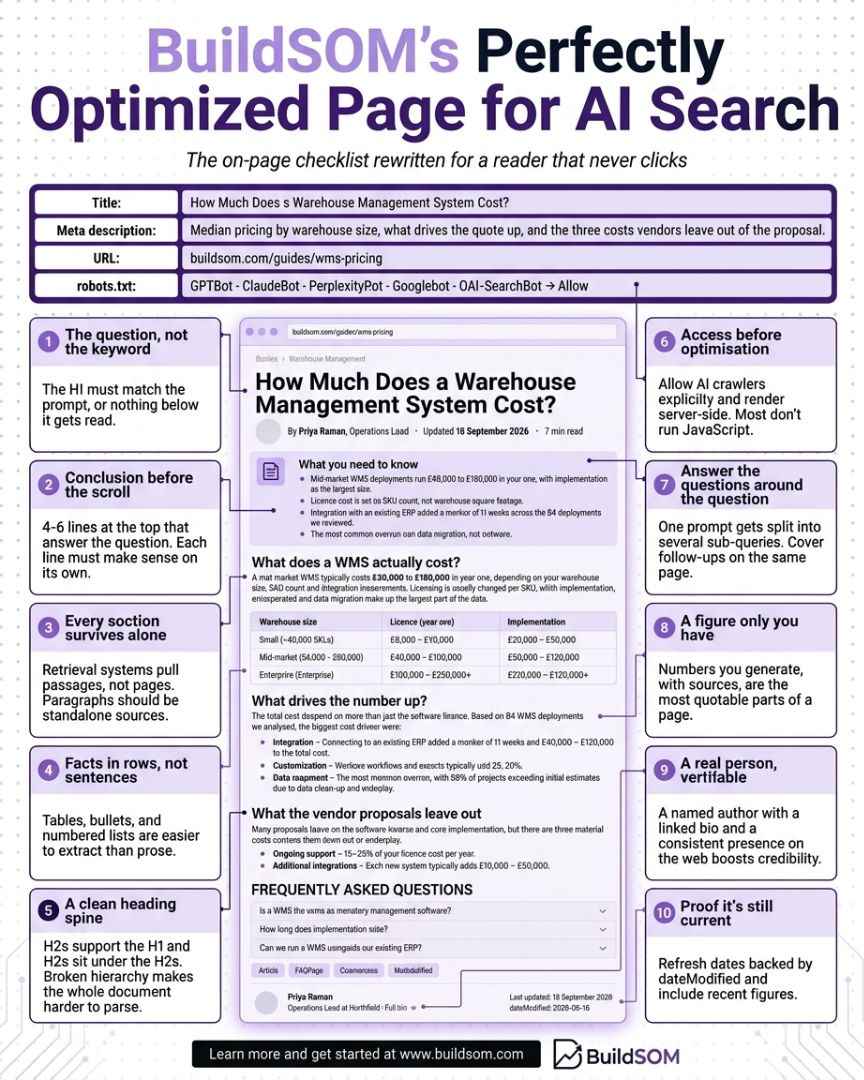
The 10-Step On-Page Checklist for AI Search Optimization
Search engines are fundamentally shifting from link-indexing algorithms to answer-synthesizing AI agents. Modern generative engines—such as OpenAI's ChatGPT/OAI-SearchBot, Anthropic's ClaudeBot, PerplexityBot, and Google's Gemini-powered search—do not just display ten blue links. Instead, they retrieve, evaluate, and synthesize passages directly into concise, conversational answers for users who rarely scroll or click through.
To remain visible in an era of conversational retrieval, digital marketing and content strategies must evolve from traditional Search Engine Optimization (SEO) to Generative Engine Optimization (GEO).
Below is the definitive 10-point checklist for structuring web pages so AI search engines can easily fetch, interpret, and cite your content.
1. Target the Question, Not Just the Keyword
Traditional SEO focuses on high-volume search terms like "WMS pricing" or "ERP comparison." AI search engines, however, operate on intent-driven natural language prompts.
Match the H1 to natural prompts: Formulate primary titles (
H1) as explicit, conversational questions that mirror how real users prompt LLMs (e.g., "How Much Does a Warehouse Management System Cost?").Avoid clickbait titles: AI models evaluate intent alignment before reading the rest of the document. If the
H1does not directly map to the core prompt, the underlying content is far less likely to be parsed.
2. Ensure Server-Side Crawling Access
Before an AI engine can cite your content, its specialized web crawlers must be allowed to access and render your page.
Explicitly permit AI user-agents: Update your
robots.txtto grant explicit access to leading LLM crawlers:PlaintextUser-agent: GPTBot User-agent: ClaudeBot User-agent: PerplexityBot User-agent: Googlebot User-agent: OAI-SearchBot Allow: /Render server-side: Many AI crawlers do not execute complex client-side JavaScript when scraping content. Ensure core copy and data structures are fully rendered on the server side so crawler bots consume clean HTML directly.
3. Place the Conclusion Before the Scroll
LLMs prioritize immediate, high-density answers near the top of the content payload.
The 4–6 line summary: Feature a structured summary box at the very top of the article (directly beneath the title and author bio).
Standalone sentences: Ensure each bullet point or sentence within this summary makes complete sense on its own, enabling the AI retriever to extract and quote individual statements directly.
4. Build Self-Contained Passages
Modern AI search relies on Retrieval-Augmented Generation (RAG) models. These systems pull granular passages, not entire web pages.
Avoid relative dependencies: Do not rely heavily on cross-paragraph pronouns or transitional phrases like "as mentioned above" or "in the previous section."
Contextual independence: Structure every section so it functions as a standalone micro-source, providing full context even if read in isolation.
5. Format Facts into Structured Data Structures
AI algorithms extract numerical data, lists, and comparisons much more reliably from structured formatting than from dense prose.
Prefer tables and bullet points: Convert critical data points—such as pricing tiers, software feature matrices, or technical specifications—into Markdown tables or explicit lists.
Real-world example:
| Warehouse Size | Licensing Cost (Per Year) | Implementation Cost |
| Small (< 40k SKUs) | £8,000 – £20,000 | £20,000 – £50,000 |
| Mid-Market (54k – 280k SKUs) | £40,000 – £100,000 | £50,000 – £120,000 |
| Enterprise | £100,000 – £250,000+ | £220,000 – £120,000+ |
Source: Internal Deployment Data (84 Deployments Analyzed)
6. Address Sub-Queries Around the Core Question
When a user submits a prompt to an AI engine, the LLM frequently splits that single query into multiple sub-queries behind the scenes (known as query fan-out).
Preempt follow-up prompts: Dedicate sections to answering natural follow-up questions directly on the same page.
Integrate explicit FAQ sections: Use
H3tags or accordions targeting secondary queries like "What drives implementation costs up?" or "What do vendor proposals omit?" to capture long-tail sub-query retrievals.
7. Feature Verifiable, First-Party Data
AI models favor proprietary data points over generic, rehashed advice. Proprietary statistics give models original figures to cite as primary authority.
Publish original numbers: Include specific data points from primary research or case studies (e.g., "Based on 84 WMS deployments analyzed, the average integration delayed go-live schedules by 11 weeks").
Attribute sources clearly: Provide clear methodology notes so AI models can verify the provenance of your figures.
To see how these principles apply to modern web development and search architecture, explore more insights and technical frameworks at BuildSOM.
8. Maintain a Clean Heading Spine
AI parsing engines use heading hierarchies (H1 H2 H3) to construct an internal table of contents and map relationship dependencies within a document.
Strict logical hierarchy: Use exactly one
H1for the core title, followed byH2s for main sections, andH3s strictly nested underH2s.Avoid broken structures: Skipping heading levels (e.g., jumping from
H1directly toH3) disrupts the semantic parser and makes passage boundary detection less effective.
9. Establish Verifiable Author Authority (E-E-A-T)
AI models evaluate the credibility of content creators by verifying identity signals across the broader web.
Include named author bios: Avoid publishing under generic handles like "Admin" or "Editorial Team". Use full legal names alongside professional titles (e.g., "Priya Raman, Operations Lead").
Link to structured credentials: Provide direct links to complete author bios and verified social profiles (e.g., LinkedIn) to reinforce Experience, Expertise, Authoritativeness, and Trustworthiness (E-E-A-T).
10. Implement Explicit Freshness Signals
Generative engines favor up-to-date information and actively filter out stale data for fast-evolving topics.
Display visible refresh dates: Include clear text showing both original publication dates and recent modification dates (e.g., "Updated 18 September 2026").
Embed Schema metadata: Use
dateModifiedanddatePublishedproperties within structuredArticleorTechArticleJSON-LD markup to provide unambiguous freshness signals to web scrapers.
{
  "@context": "https://schema.org",
  "@type": "TechArticle",
  "headline": "How Much Does a Warehouse Management System Cost?",
  "datePublished": "2026-05-16",
  "dateModified": "2026-09-18",
  "author": {
    "@type": "Person",
    "name": "Priya Raman",
    "jobTitle": "Operations Lead"
  }
}
Technical On-Page GEO Checklist
| Feature | Technical Implementation | Optimization Target |
| Robots Directives |
| Server Crawlability |
| Rendering | Server-Side Rendering (SSR) | Crawler Parsing Speed |
| Document Hierarchy | Strict | Passage Boundary Mapping |
| Data Formatting | Markdown Tables / Bulleted Lists | Numerical Extraction |
| Schema Markup | JSON-LD ( | Entity & Freshness Verification |
By shifting your optimization strategy from traditional keyword density to logical structuring, self-contained passage design, and verified data presentation, you ensure your content remains discoverable, quote-worthy, and dominant in the age of AI search.