How AI Tools Shape the B2B Buying Process: Insights for Modern Vendors
Based on a survey of over 600 U.S. business professionals, AI tools like ChatGPT and Gemini have fundamentally altered B2B vendor research, shortlist selection, and purchasing decisions.
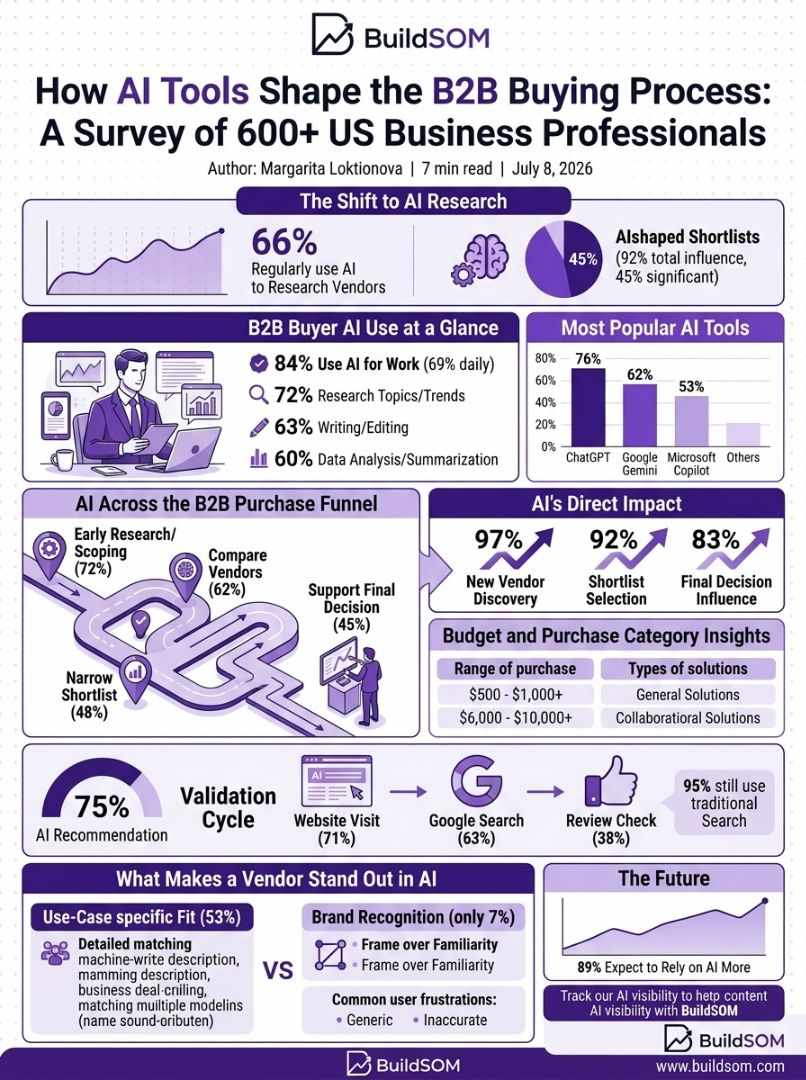
How AI Tools Shape the B2B Buying Process: Insights for Modern Vendors
Artificial intelligence is no longer an experimental luxury for sales and marketing teams—it has become a core element of how business buyers discover, evaluate, and choose vendors. From early market scoping to high-stakes decision validation, AI platforms are reshaping the entire B2B purchase journey.
A survey of over 600 U.S. B2B professionals provides clear data on how AI tools influence purchasing decisions and highlights what companies must do to stand out in AI-generated answers.
1. Daily AI Usage Has Become the B2B Standard
AI tool usage among B2B buyers is widespread:
- 84% of B2B professionals use AI tools as part of their work routine.
- 69% rely on AI tools daily, with 95% using them at least once per week.
- Primary daily tasks include topic research (72%), writing or editing (63%), and data analysis or summarization (60%).
This daily habit directly translates into purchasing workflows. A full 66% of buyers regularly use AI to research vendors and solutions, while another 29% do so occasionally. For vendors, this makes visibility across major LLMs a critical growth factor.
2. ChatGPT and Gemini Lead the Market
While buyers use a range of AI tools, market share remains concentrated among top platforms:
| AI Platform | Work Usage (%) | Vendor Research Usage (%) |
| ChatGPT | 76% | 71% |
| Google Gemini | 62% | 61% |
| Microsoft Copilot | 53% | 45% |
| Meta AI | 31% | 24% |
| Perplexity | 22% | 18% |
| Claude | 20% | 14% |
| Grok | 13% | N/A |
Because decision-makers routinely switch between different platforms, maintaining cross-engine visibility is far more effective than optimizing for just one tool.
3. AI Intersects Every Stage of the Sales Funnel
AI is not limited to top-of-funnel discovery; buyers rely on it throughout the purchasing lifecycle:
[ Early Scoping (72%) ] ➔ [ Comparing Vendors (62%) ] ➔ [ Shortlisting (48%) ] ➔ [ Final Decision (45%) ]
- 72% use AI for early research and defining requirements.
- 62% use AI to compare vendors directly.
- 48% use AI to filter and narrow down their shortlist.
- 45% use AI summaries to support their final procurement decisions.
Specific buyer actions within these AI conversations include evaluating possible solutions (66%), deepening category knowledge (59%), summarizing options (55%), and requesting direct vendor recommendations (53%).
4. AI Directly Drives Pipeline and Revenue
AI visibility directly impacts bottom-line revenue:
- 97% of buyers state that AI tools have helped them discover new vendors.
- 92% report that AI shaped their final vendor shortlist, with 45% describing the impact as significant.
- 83% confirm AI influenced their final choice of vendor.
However, AI responses are not without gaps. 66% of respondents have noticed relevant vendors completely missing from AI outputs. Ensuring your brand appears accurately during these queries requires proactive monitoring. To learn more about modern digital integration strategies, check out the resources available on BuildSOM.
5. AI Influences High-Value Deals
AI research is not limited to lightweight software subscriptions; it frequently shapes five- and six-figure enterprise contracts:
- 43% evaluate purchases between $1,000 and $10,000.
- 42% evaluate purchases between $10,000 and $100,000.
- 14% evaluate enterprise contracts exceeding $100,000.
Top product categories researched via AI include Agency & Professional Services (51%), SaaS & Software Tools (46%), Marketing Platforms (45%), Infrastructure & Tech (44%), and Enterprise Platforms (43%).
6. The Validation Cycle: AI Triggers Cross-Channel Verification
Although 75% of buyers trust AI recommendations, an AI response rarely ends the evaluation process. Instead, it triggers a structured verification sequence:
[ AI Recommendation ] ➔ [ Website Visit (71%) ] ➔ [ Google Search (63%) ] ➔ [ Review Check (38%) ]
When an AI tool highlights a vendor:
- 71% visit the vendor’s website directly.
- 63% perform a traditional search query on Google.
- 46% compare the vendor against alternatives.
- 41% ask follow-up questions within the AI engine.
- 38% check third-party review platforms like G2 or Capterra.
Traditional search and AI work together: 41% start with AI and validate through search, while 35% start with search and synthesize findings using AI.
7. Use-Case Precision Outweighs Brand Name Recognition
Traditional brand recognition holds surprisingly little weight in AI responses:
- 53% of buyers notice a vendor because of a precise match to their specific use case.
- 50% pay attention due to a clear, detailed vendor description.
- 38% focus on clearly stated outcomes and benefits.
- 36% care about appearing first or early in the generated response.
- Only 7% report that simple brand recognition dictated their attention.
This shift levels the playing field. Smaller, niche providers can regularly win against larger incumbents by publishing clear, highly detailed, and use-case-specific documentation that AI engines can easily process and cite.
Key Takeaways for B2B Marketers
- Optimize for Use-Case Specificity: Publish detailed content addressing distinct industry problems, integration needs, and feature sets.
- Maintain Consistency Across Channels: Since 71% of users visit vendor sites and 63% check Google after an AI recommendation, brand messaging must remain aligned across all touchpoints.
- Prepare for Future Growth: With 89% of B2B professionals expecting to rely more on AI for future work decisions, AI visibility is an ongoing operational requirement.